


'No country should be allowed to threaten another': Pezeshkian urges BRICS to oppose normalisation of attacks
By Arti Bali
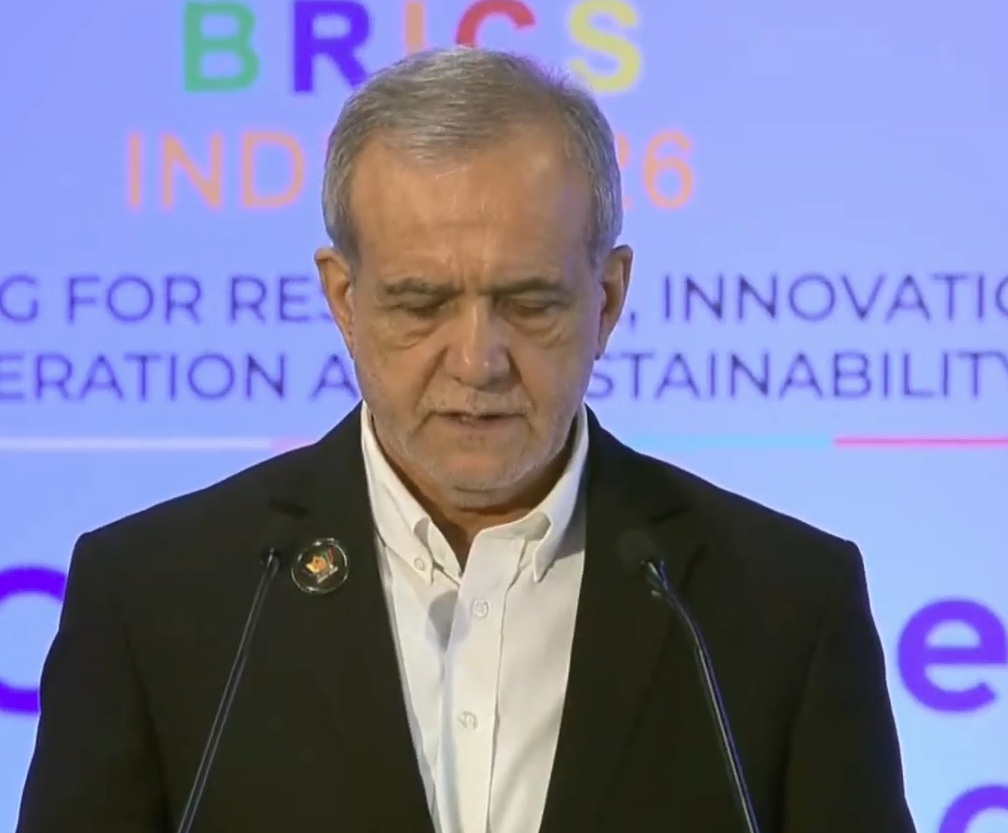
New Delhi, Sep 12 (UNI) Iranian President Masoud Pezeshkian on Saturday used the BRICS summit to criticise the US and Israel over their attacks on Iran, saying no country should be allowed to use its territory to threaten or attack another.
He urged the bloc to prevent attacks on civilians and critical infrastructure from becoming normalised. Addressing the BRICS summit in New Delhi, Pezeshkian said sustainable security could only be achieved through respect for national sovereignty and international law, and stressed that peaceful nuclear facilities must remain immune from attack or threats. "No country should use its territory to threaten or attack another.
The BRICS summit must stand against the normalization of attacks on civilian and critical infrastructure, and peaceful nuclear facilities must be immune from attack and threats of attack," he added. His remarks came as the US-led war entered seventh month and still US attacks oil tankers in the Strait of Hormuz that Tehran has condemned as violations of its sovereignty.
Pezeshkian said attacks on peaceful nuclear facilities were not merely a matter concerning individual countries but a threat to international peace and security. "The same principle applies to peaceful nuclear facilities; these facilities must remain immune from attack and threats of attack, because endangering them is not an issue limited to one country, but a threat related to international peace and security," he said. Pezeshkian sharply criticised the existing international system, saying the credibility of global governance depended on its ability to protect all countries, regardless of their size or power.
"If the United Nations Charter cannot protect nations against the unlawful resort to force, and if international rules are binding for some and open to interpretation for others, one cannot speak of genuine multilateralism," he said. Referring to attacks, including the strike on a school in Minab and the attack on Lamerd, he said inaction by the United Nations and its Security Council could have direct consequences for human lives. He also highlighted the suffering of Palestinians in Gaza, questioning the legitimacy of a multilateral system that could not protect civilians and national sovereignty against war, genocide and aggression.
"If the multilateral system cannot protect human lives and the sovereignty of countries against war, genocide and aggression, how can its legitimacy be trusted?" he said, calling for genuine reform rather than a response limited to statements. The Iranian president outlined four priorities for more inclusive global governance: equal respect for national sovereignty and international law, reform of the UN Security Council and international financial institutions, greater use of national currencies and independent payment mechanisms, and a serious response to unilateral sanctions. Referring to the massive sanctions imposed by the US under the 'Operation Economic Outcast", the Iranian leader said Tehran supported three key processes within BRICS -- stronger political coordination among members in defence of the UN Charter and national sovereignty; expanded economic and financial cooperation independent of monopolistic instruments; and greater cooperation in science, technology, energy and food security, particularly for countries of the Global South.
"The subject of this meeting -- inclusive global governance and strengthening multilateralism -- is today of twofold importance," Pezeshkian said, noting that while countries were increasingly interdependent in dealing with common crises, unilateralism, pressure and the use of financial and technological systems as instruments of coercion were also growing.
He called for stronger BRICS coordination and a justice-centred international order, saying sustainable cooperation was impossible without justice. "Multilateralism is meaningful when all are equal before the law, and global governance will have legitimacy when the voice of developing countries is heard," he said. Pezeshkian said Iran was ready to work with BRICS towards a system where "power does not take the place of law, sanctions do not take the place of cooperation, war does not take the place of dialogue."


